| ZetaWare Quick Seal Capacity Calculator |
| Home | Log Viewer | Ternary | UTM | Stiff | Source Potential | BHT Correction | CO2 Storage | H2 Volume | Rift Beta |
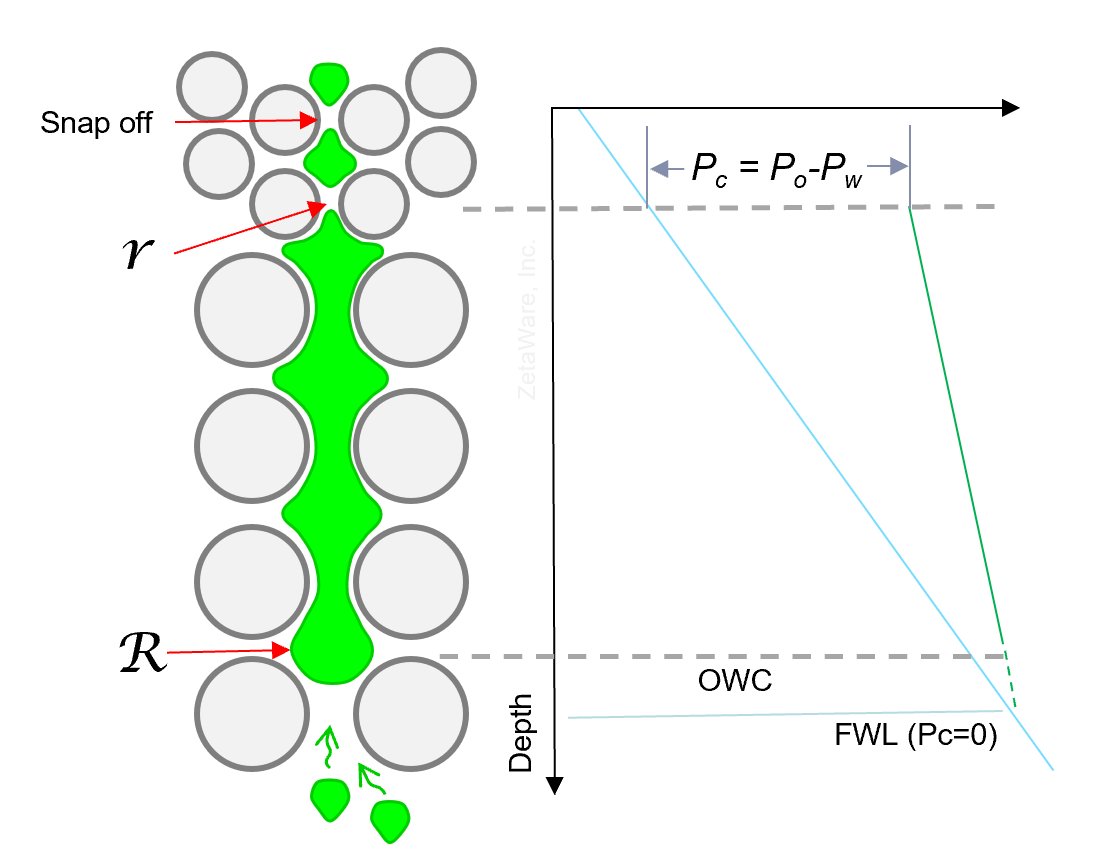 |
As a trap is filled, the HC column increases until buoyancy of the column is equal to the displacement pressure, Pd, of the seal. Additional oil added at the bottom will cause buoyancy to exceed Pd and the HC starts to migrate through the seal as a connected stringer. When no new HC is added, the buoyancy is balaned with Pd, the stringer breaks apart (snaps off) at the smallest pore throats due to strong capillary pressure at these locations and becomes disconnected . This process repeats and the same HC column is retained. This is analogues to a dam on the river that spills off any additional water.
Near the top of the reservoir, buoyancy (= capillary pressure) pushes oil into smaller pore spaces and corners resulting in higher oil saturation. Near the bottom of the column, buoyancy is low, so oil is only in the large pore space, and thus oil saturation is low. Buoyancy force is transformed into capillary pressure (Pc = Po – Pw), which is what pushes the oil into smaller pores. It is a form of potential energy. |
γ is the interfacial tension between the HC and water.
θ is the contact angle (wettability).
r is the pore throat size of the seal.
R is the pore size of the reservoir. Assuming it is at least 10 times larger than r, and can be ignored.
g is acceleration of gravity 9.8 m/sec2.
ρw is subsurface density of water.
ρhc is subsurface density of HC fluid.
To make the equation work out with column height (H) in meters, use SI units for all parameters: γ (N/m), r (m), R (m), g (9.8 m/s2), ρw and ρhc kg/m3.
To convert MICP displacement pressure Pd to r, the largest connected pore throat size of the seal. \[ r = - 2 \cdot γ \cdot cos(θ)/Pd \hspace{6cm} (2) \]
where γ, the interfacial tension between mercury and air, is 0.48 N/m (480 dynes/cm). Contact angle θ is 140°. If you want r to be in meters, Pd needs to be in Pascals (1 Pa = 1 N/m2, and 1 psi = 6894.76 Pa ). For a quick manual convertion, equation (2) is reduced to:
\[ r(μm) = 107/Pc(psi) \hspace{6cm} (3) \]
The capillary pressure, Phc - Pw, at the crest of the HC column, is equal to the HC water displacement pressure. To convert Mercury-air displacement pressure Pdma to hydrocarbon water displacement pressure, Pdhw:
\[ Pd_{hw} = { γ_{hw} \cdot cos(θ_{hw}) \over γ_{ma} \cdot cos(θ_{ma}) } \cdot Pd_{ma} \hspace{5cm} (4) \]
The pressure gradient in the HC column, in psi/ft, is equal to 0.433*ρhc/1000.
The displacement pressure from MICP has uncertainties related to how to pick Pd from a MICP curve, some may use Pc at 10% saturation as Pd. The bigger uncertainty with Pd estimate is if the sample represents the actual seal. Within the finite thickness of the seal, the MICP properties may vary a lot. The actual seal may be somewhere in the middle of that shale unit.
Interfacial tension (IFT) is rarely measured these days, certainly not before we drill the well. Oil-water IFT may vary from 10 to 40 dynes/cm, and gas-water probably ranges between 30 to 60 dynes/cm, with higher IFT at low pressure (shallow depth) and dry gas. As IFT is emperature dependent, we need to be using in-situ values that are usually lower than some published numbers.
Contact angle for a completely water wet seal rock is 0. If the seal rock becomes mixed wet, you may use a larger angle. Clay rich shales are generally considered water wet.
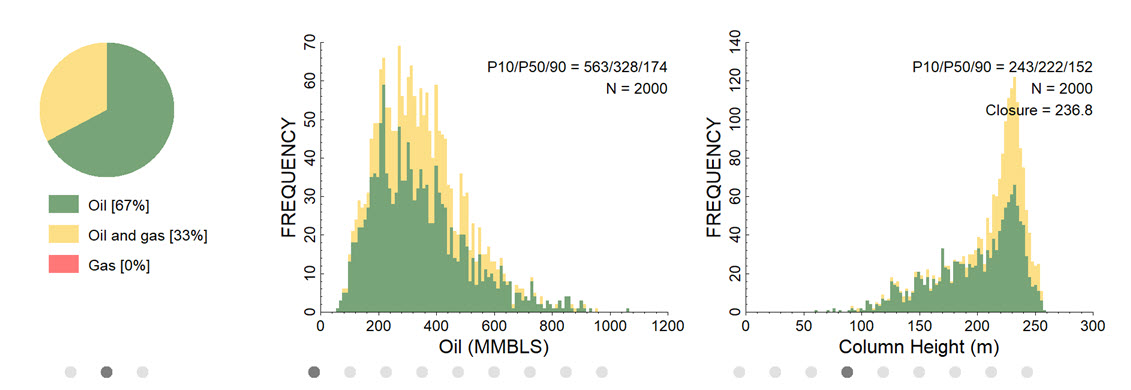
In our PSA toolkit, Trinity 3D, we use a probabilistic method to make predictions about the seal capacity / column height, in single and dual phase (gas cap and oil leg) conditions as well as volumes and fluid properties.
T. Schowalter, 1979, Mechanics of Secondary Hydrocarbon Migration and Entrapment, AAPG Bulletin, Vol 63, No. 5.
Copyright ©2025, ZetaWare, Inc. All rights reserved